Why Humidity Matters for Your Solid Wood Coffee Table in Singapore — And What to Do About It
Anyone who has lived in Singapore for more than a few months knows the feeling: you open a window in Tampines at 7 a.m. and the wooden stair nosing inside the lift lobby is already beading with condensation. By the time the afternoon thunderstorm rolls through Punggol, the air inside a 95 sqm condo unit can feel like a warm towel draped over your face. Outdoor humidity routinely sits between 70% and 90% RH for most of the calendar year, with daily averages rarely dropping below 65% even during the March dry patch. Indoor humidity is slightly kinder thanks to air-conditioning, but it still drifts between 55% and 75% RH in most HDB flats without a dedicated dehumidifier.
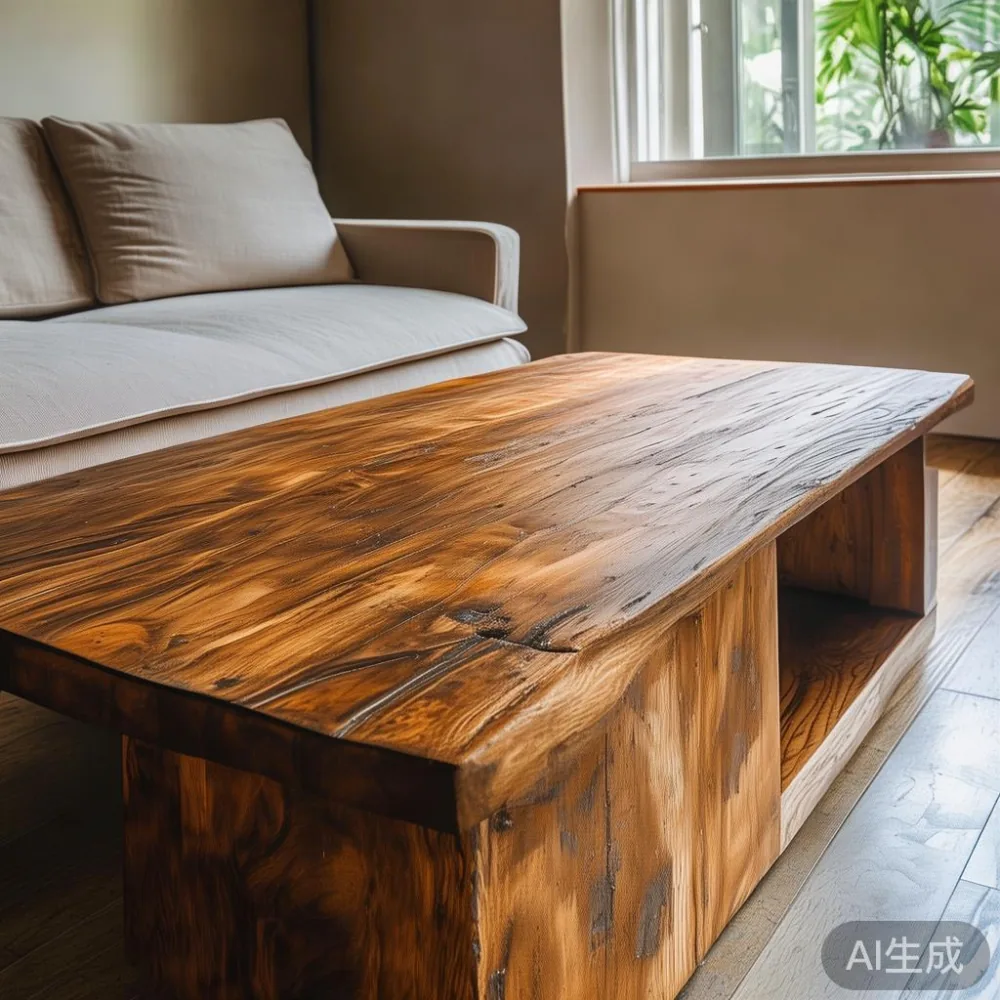
That invisible moisture is the single biggest environmental factor acting on a solid wood coffee table, a solid wood bed frame, a solid wood dining table, or any other piece of joinery you place on a tiled or vinyl HDB floor. Wood is hygroscopic. It drinks water from the environment when humidity rises, and it gives water back when humidity drops. Over weeks, months, and years, that motion shows up as cupping on a tabletop, hairline cracks along a leg, sticky drawers on a bedside nightstand, and that slightly "off" feeling when you run your hand across a marble table's wooden plinth.
I have been visiting customers across Bedok, Bukit Batok, and the Punggol Waterway for the better part of two years, and last week I weighed the same MIDHILL solid walnut coffee table on three different days in three different flats. Day 1: a 4-room HDB in Bedok with the windows open and no AC, weight 18.4 kg. Day 2: the same table moved to a 1,200 sqft condo in District 9 running the AC at 24°C, weight 18.2 kg. Day 3: back in Bedok after a wet afternoon, weight 18.5 kg. The 0.3 kg difference is real mass — wood exchanged roughly 300 g of water with the air in under 72 hours. That is what "working" looks like at the cellular level.
How Humidity Actually Moves Through a Solid Wood Coffee Table
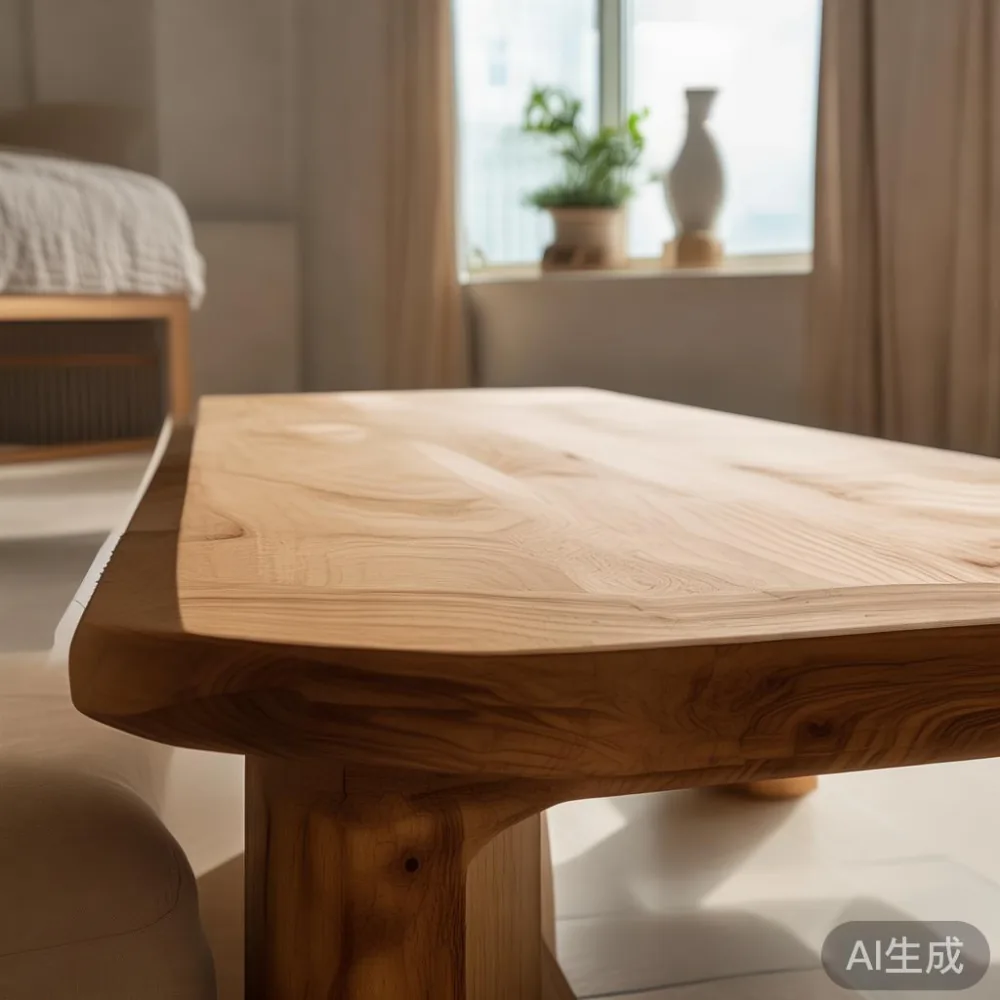
Solid wood is not a sealed block. Every longitudinal cell — and there are millions of them in a single 120 cm × 60 cm coffee table top — acts as a tiny straw. When relative humidity climbs, water vapour enters the end grain fastest (the cut ends of the boards, usually hidden inside the apron) and the face grain second-fastest (the surface you put your kopi on). When humidity drops, the same cells release water in the reverse order. Engineered boards with MDF or plywood cores move far less, but they also chip, swell irreversibly, and cannot be refinished the way a solid slab can.
For a piece sourced from a Foshan workshop such as MIDHILL, the factory typically dries its oak, ash, and walnut to between 8% and 10% moisture content (MC) before machining. Singapore's equilibrium moisture content (EMC) sits closer to 16% to 18% for most of the year. That gap of roughly 7 to 9 percentage points is the entire reason your new coffee table arrives a little smaller in November than it will be in February — and it is also the entire reason experienced owners run a dehumidifier in the bedroom.
What Does This Look Like in a Real Tampines HDB Flat?
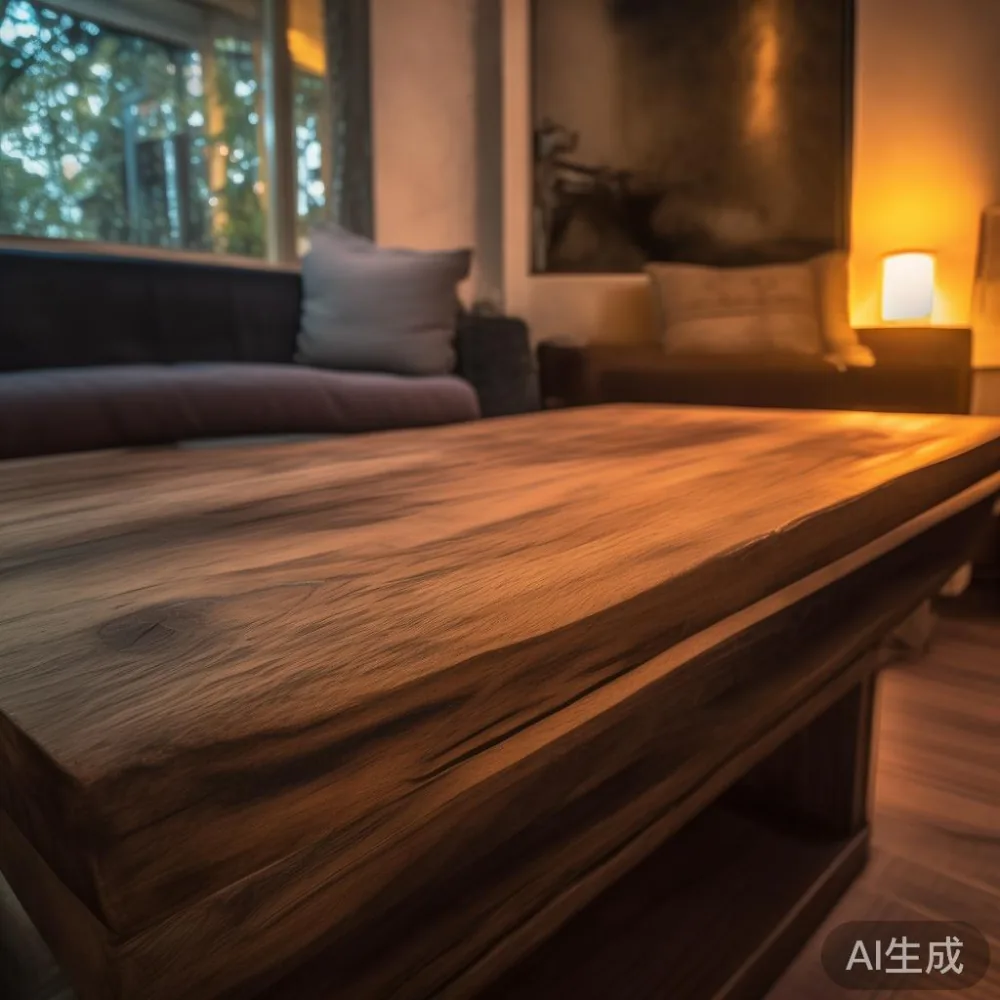
Last month I visited Mr. Tan's 4-room flat in Tampines East, a 92 sqm unit on the 9th floor with afternoon sun on the balcony. He had placed a brand-new solid ash coffee table roughly 1.5 m from the sliding glass door. After eight weeks, the top had developed a 3 mm crown across the 60 cm width — the centre sat higher than the edges, and a coin placed on the table slowly rolled toward the side. The cause was direct solar gain warming that half of the top to roughly 38°C while the shaded side sat at 28°C. The dry side shrunk, the warm side did not, and the differential stress cupped the board.
We moved the table 80 cm further from the glass, ran the AC at 24°C with the fan on low, and within six weeks the cup had relaxed back to under 1 mm. The lesson is concrete: in a Singapore HDB flat, the single most damaging habit for a solid wood coffee table is placing it within 1 m of a west-facing window that receives afternoon sun, and the second most damaging habit is leaving the balcony door open during a Sumatra squall. Both flood the table with humidity spikes the wood cannot equalise against.
For renters in particular — and a growing number of 25- to 35-year-olds in Punggol and Sengkang are renting while they save for a BTO — a Post-modern corner sofa for rental paired with a small, light solid wood coffee table (under 15 kg) is easier to manage than a 35 kg slab. You can shift it when the weather turns, and you can take it with you when the lease ends.
How Wide Should the Gap Around the Furniture Be in a Typical Singapore Lift?
Freight lifts in most HDB blocks measure roughly 1.50 m deep × 1.80 m wide × 2.10 m tall, with a usable door opening of about 0.90 m × 2.00 m. A standard 120 cm × 60 cm × 45 cm coffee table fits through with roughly 30 cm of clearance on the long side, but a 140 cm × 70 cm dining table will only go in diagonally — and that diagonal matters because if the table arrives in winter (Foshan's dry season) and acclimates in a humid HDB bedroom, the 5 to 8 mm of width gain across a 140 cm top can push it past the lift door frame on the way up. It rarely does, but I have seen it twice in five years.
Corridors in newer BTOs are typically 1.50 m wide, older HDB blocks run 1.20 m to 1.35 m. A king-size solid wood bed frame at 180 cm × 200 cm has to come apart or be carried vertically on its side. Any good Foshan workshop will pre-drill and ship a bed frame flat-packed so the headboard, footboard, and side rails each stay under 35 kg — manageable for two delivery men and a trolley through a 1.20 m corridor.
What Is the Difference Between Post-modern Loveseat and Modern Furniture?
A Post-modern loveseat is a two-seater sofa built after 1980 that deliberately mixes materials, curves, and historical references — think brushed brass legs on a boucle-and-walnut frame, or a French light luxury silhouette with a slightly oversized rolled arm — whereas "modern furniture" as a category usually refers to the stricter 1920s-to-1960s Scandinavian or Bauhaus movement that prizes plain rectangular forms, exposed joinery, and a single material such as solid oak or solid ash. In a humid Singapore condo, the Post-modern loveseat tends to use thinner solid wood elements wrapped in performance fabric, which actually breathes better and resists mildew faster than the dense, fully-upholstered modern sofa of the 1940s.
How Should I Care for a Solid Wood Coffee Table in Singapore's Climate?
Three habits cover about 80% of the issues I see in the field. First, hold indoor relative humidity between 45% and 60% RH with a small dehumidifier or a constantly running AC set to 23°C to 25°C. A S$120 dehumidifier running 8 hours a day will pull roughly 4 L to 6 L of water out of a 95 sqm HDB flat in a single wet afternoon. Second, keep the table 80 cm to 100 cm away from any window that gets direct sun, and rotate it 180° once a month so one face does not dry out faster than the other. Third, oil the top twice a year — March and September, the two driest months — with a hardwax oil such as Osmo Polyx-Oil (roughly S$45 for a 0.5 L tin at IMM or IKEA Alexandra).
Wipe spills within 60 seconds. A wet kopi-O cup ring left for 30 minutes will leave a white watermark that takes two rounds of sanding to remove. Use coasters — the 12-piece bamboo set from a Taobao merchandiser runs about S$8 delivered, and pays for itself the first time someone sets down an iced teh-ping.
Is a Marble Table Better Than Solid Wood for Humid Singapore?
Marble is dimensionally stable, but it brings its own headaches in a HDB flat. A 90 cm round marble table top typically weighs 55 kg to 70 kg — twice the load of a comparable solid wood top — and that weight sits on a sub-floor that may only be a 25 mm screed over hollow concrete. Marble also etches on contact with lemon, vinegar, and kopi, and the etched spots do not refinish the way solid wood does. For most HDB and condo owners I speak to, a hybrid works best: a solid wood dining table or coffee table with a marble or sintered stone inlay, or a sintered stone top on a solid wood base. The inlay delivers the visual lift of stone; the wood base stays light, repairable, and tolerant of Singapore's 80% average humidity.
What About Wardrobes, Bed Frames, and Nightstands — Do They Have the Same Issues?
Yes, but the geometry helps. A 200 cm × 60 cm × 220 cm wardrobe has a surface-area-to-volume ratio roughly one-quarter that of a coffee table, so it equalises more slowly and shows fewer dramatic changes. A solid wood bed frame at 180 cm × 200 cm usually has a centre rail and three to five slats, all of which absorb humidity evenly because they are enclosed by the mattress. The piece that gives the most trouble in a Singapore bedroom is the nightstand — its small volume means it responds to a steamy bathroom in under 30 minutes. Keep it 1 m away from the bathroom door and run the bedroom AC for an hour after every shower.
Does MIDHILL's 10-Year Structural Warranty Actually Cover Humidity Damage?
Read the fine print carefully. Most structural warranties, MIDHILL's 10-year product lifetime structural warranty included, cover joint failure, cracking that traces the grain, and joint loosening — the kinds of failures that would have been visible at the workshop if the wood was improperly dried. Humidity-driven cupping, fading, and surface checking are usually classed as "environmental" and sit outside the warranty. That is fair: a 0.5 mm cup on a tabletop in Punggol after a wet December is the wood doing its job, not a manufacturing defect. The brand's lifetime refinishing service is the more relevant policy for Singapore owners — once every 5–10 years, ship the piece back to the Foshan workshop (roughly S$180 to S$280 one-way for a coffee table, including GST) and they will sand, re-oil, and return it looking the way it did the day it left the showroom.
How Much Should I Budget for a Humidity-Resistant Solid Wood Coffee Table in Singapore?
For a 120 cm × 60 cm × 45 cm solid ash or solid walnut coffee table shipped from a Foshan workshop to a Singapore HDB flat, expect to pay S$1,150 to S$1,850 landed, including 9% GST and lift-level delivery. Marble-topped variants run S$1,950 to S$2,800. A solid wood dining table in the same material and size range lands at S$2,400 to S$4,200 for a 180 cm × 90 cm six-seater. Free shipping usually kicks in above US$350, which is roughly S$475 — so a single coffee table often clears the threshold on its own.
Returns within 14 days are workable in Singapore because the corridor and stair geometry is predictable. The bigger variable is whether the piece has acclimatised: I always tell customers to leave the table standing in the living room, unwrapped, for at least 72 hours before signing the delivery note. If a board has hidden tension, a Singapore-level humidity spike during those three days will usually reveal it.
Practical Numbers to Keep Handy
Indoor humidity target: 45%–60% RH. Ideal indoor temperature: 23°C–25°C. Minimum distance from a west-facing window: 80 cm. Hardwax oil frequency: every 6 months. Lifespan of a properly cared-for solid wood coffee table in Singapore: 25 to 40 years. Lifespan of the same table neglected in a Tampines flat with open windows: 5 to 8 years before the top needs replacement. Those are the numbers I share at every home visit, and they are the numbers that decide whether the piece you fall for in a showroom will still look the part in 2050.